

Chargepoint mapping service provider Zapmap has published new statistics on public chargepoint installations throughout 2025 in the UK.
The figures were taken from the Zapmap database at the end of December 2025 and show 14,316 new charge points were installed throughout 2025.
Reportedly, electric vehicle (EV) charging infrastructure now encompasses 87,796 devices (116,052 EVSEs) at 45,033 locations spanning en-route, destination and on-street charging, representing a year-on-year increase of 19.5%.
Zapmap’s statistics demonstrated regional growth taking place outside of London and the South-East throughout 2025, especially with regard to rapid/ultra-rapid (50kW+) chargers.
The North West also saw year-on-year growth of more than 35% in these high-powered chargers, with the East of England, Wales and Northern Ireland all recording around 29% growth in this power band (albeit Northern Ireland starting from a low base).
Many destination chargers are still low powered <50kW charge points and provide charging for longer stops and top-ups, such as in car parks and at tourist attractions.
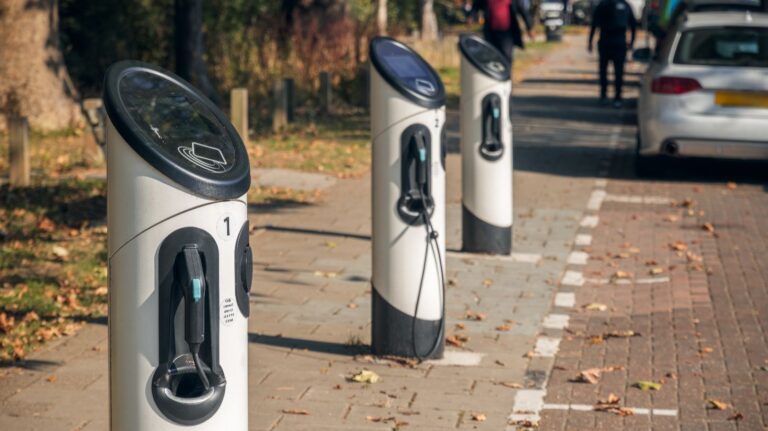
Combined with on-street charging, also predominantly <50kW, there are 69,861 charge points in this category representing just under 80% of the total.
The capital continues to lead the way on both EV adoption and on-street charging, with the majority of these chargers (24,026) located in Greater London.
The growth in on-street provision throughout both Greater London and the rest of the UK is comparative at around 30% year-on-year for both.
The latter half of 2025 saw many announcements around the award of LEVI (Local Electric Vehicle Infrastructure) contracts.
With the tender and commercial contract process for these awards taking longer than initially expected, we are yet to see these announcements translating into a significant impact on the figures.
Co-founder & COO at Zapmap, Melanie Shufflebotham, said: “While overall charging infrastructure installations are lower than 2024, this year has been marked by targeted areas of focus with both public and private sectors giving thought to shaping the EV market to best meet driver needs.
“The growth in ultra-rapid charging in particular is not only providing convenience and confidence to existing EV drivers but also, due to their typically visible locations, assuring the next wave of drivers looking to make the switch that the infrastructure is there where it’s needed most.
“As we move into 2026, we look forward to LEVI fund awards translating from contracts into near-home charging provision, to increase equitable access for those without access to off-street parking.”