

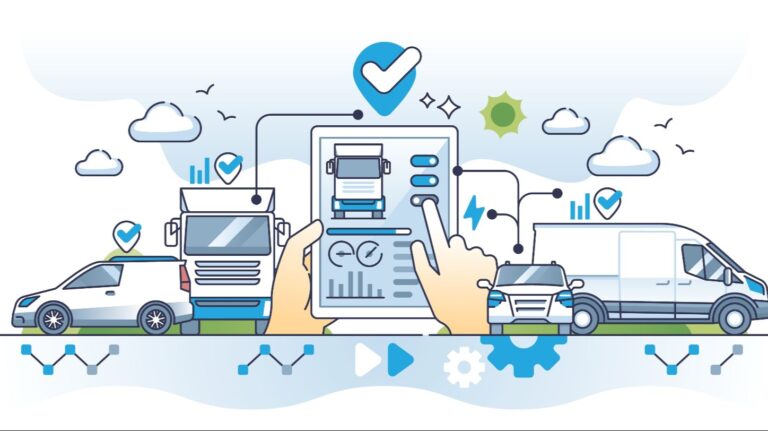
As e-commerce growth, traffic congestion and mixed-energy fleets drive up complexity, operators are turning to connected telematics platforms to keep vehicles productive and drivers safe.
Deliveries both great and small require a complex network of industries working in tandem to complete what for many is as simple as a click of a button. This paradox of intricate simplicity has no greater proponent – in logistics – than fleet operations. After packages are collected in a centralised space, fleets of vehicles collect sorted items to deliver them to individual locations.
This sounds simple enough, but to satisfy customer demands and optimise storage efficiency, deliveries must be completed within an increasingly smaller time frame. E-commerce and last-mile delivery have exacerbated these challenges by normalising quick turnaround times, placing further emphasis on fast delivery and restocking to maximise space utilisation and shorten delivery times.
Additionally, the sheer demand within, and the density of, urban areas necessitate the use of mixed-use fleets to complete deliveries. For operators, mixed fleets compound timescales considerably. Dynamic environments must be considered differently depending on the vehicle, with traffic management, routing, signal considerations and specific carrying capacities modulating operations. It is thus vital that fleet telematics be advanced enough to orchestrate the larger logistical needs across increasingly larger fleets.
Telematics data is streamed directly from either the operator or pre-loaded on small devices within individual vehicles. Such devices can store and send data regarding vehicle mileage, performance and overall condition, in addition to drivers’ delivery interface systems. Whether hardwired into the vehicle or operated through replaceable software, fleet telematics technology has come a long way from the original gilded carriages of 17th century Royal Mail, with modern vehicles receiving mapping and live traffic information enroute to their destination.
Contemporary telematics systems now act as real-time intelligence platforms that combine vehicle diagnostics, sensor and global positioning system (GPS) data to ensure fleets run safely, efficiently and sustainably. The difficulty for operators managing fleets is now how to implement advanced telemetry to stay ahead of their competition. Streamlining workflows, improving fuel efficiency and the speed at which deliveries occur is key to the industry’s future.
Failing in any of these areas risks positive feedback loops whereby negative customer feedback becomes ingrained, deteriorating existing relationships and scaring off new clients. But with every update crucial to operational success, how are fleet operators ensuring their telematics solutions stay connected and clear of digital detours?
Data means savings
Fleet requirements have evolved as the markets that necessitate them have modernised, with advanced software and hardware developed to facilitate more complex needs.
“Telematics solutions have evolved dramatically over recent years,” says Alex Crane-Robinson, regional director, UK & Ireland, at fleet management and telematics solution provider Webfleet. “What began simply as vehicle locations on a map has become real-time ‘intelligence platforms’ that help fleets run more safely, efficiently and sustainably.”
Webfleet seeks to use real-time vehicle tracking, route optimisation and driver performance monitoring to improve operational efficiency. Embedding telematics solutions within fleet management software enables both Webfleet and operators to integrate greater complexity into single systems.
“Today, systems combine location data with driver-behaviour insights, fuel and energy analysis, EV battery status and vehicle diagnostics,” Crane-Robinson continues. “This enables fleets to focus on what is having the greatest operational impact.”
With every second shortened becoming a second gained, the right telematics solution provides disproportionate benefits comparative to similar software upgrades. Fuel efficiency, for example, can make or break large-scale operators or those seeking to scale their fleets.
Improper fuel usage is magnified by the number of vehicles in the fleet, with poor fuel management quickly spiralling into a crippling financial issue. Advanced telemetry marks performance, including the fuel efficiency of different models and individual vehicles. This assists in assessing where fleets are consistently stationery, rerouting them around traffic and providing accurate mapping information to avoid problematic routes.
“Fleets are using telematics platforms to reduce fuel and energy waste, improve driving behaviour, lower insurance risk and costs, simplify compliance and minimise downtime,” Crane-Robinson continues. “For example, McCulloch Group, railroad solutions providers based in Scotland, used our insights to identify unnecessary idling and adjust driver coaching accordingly, reducing idling by more than 80% and improving fuel efficiency.”
FAST FACT: 64% of UK fleets already use – or plan to use – telematics within the next three years. Source: Arval Mobility Observatory Fleet and Mobility Barometer 2025
The Road Haulage Association (RHA) estimates that the average heavy goods vehicle (HGV) logistics fleet incurs 22-24% of its total running cost through fuel usage. This is a huge dependence on the price of what is a fluctuating commodity – no matter the fuel source. RHA’s ‘Haulage Cost Movement 2024’ report, demonstrates this, suggesting that of the nearly 500 logistics operators that collapsed in 2024, fuel inflation was a contributing factor. Additionally, built in fuel escalators or fuel duty stabilisers – a UK government policy that implements annual fuel duty rates rise to discourage pollutive fuel use – further increases operating costs.
Idling or stop-start can be particularly problematic for fleets that operate continuously, as in the case of warehouse logistics. Warehouse fleets require real-time visibility, with warehouse management systems (WMS) incorporating real-time visibility into vehicle performance. Combining WMS platforms and fuel economy into fleet management is predicated on accurate reporting via telemetry sensors.
“Depending on business goals and operational challenges, there are several different ways that telemetry data can help warehouse managers to adjust their operations,” explains Daniel Hiscock, product manager – technology and connected fleet at Yale Lift Truck Technologies. “For example, if impacts are found to be more common in certain areas, warehouse managers can use this telematics data to rearrange their facility’s layout and reduce the risk of costly impacts in the problem area.”
Defined by connectivity
Yale Lift Truck Technologies operates Yale Vision, a wireless lift truck fleet management tool designed to help materials handling operations. Within warehouses, telematics provides pre-warning of mechanical failures, enabling preventative maintenance maximising operational effectiveness. Such data can be incorporated into automated systems, too, utilising autonomous mobile robots (AMR) to support human operated machines. Data digitisation, therefore, becomes the easiest pathway to improving WMS telematics.
“Many operators have built their technology stacks incrementally, which has led to fragmented systems
and duplicated processes,” Crane-Robinson adds. “Digital transformation for fleets is now defined by connectivity, rather than the number of technologies deployed, to ensure workflows are streamlined, end-to-end processes.”
Improving connectivity leads to better telemetry and efficiency. Ensuring Internet of Things (IoT) networks integrate high-speed internet (preferably 5G), with increased bandwidth and lower latency enabling rapid telemetry to more devices. Storing data on central servers also grant operators access to larger data bases and increased real-time visibility.
“What began simply as vehicle locations on a map has become real-time ’intelligence platforms’ that help fleets run more safely, efficiently and sustainably” – Alex Crane-Robinson, regional director, UK & Ireland, Webfleet

Operators with IoT-enabled telematic solutions can manage the larger and more diverse fleets increasingly demanded across the logistics industry. Scaling operations can then consider less pollutive fuel sources, analysing the benefit of different options against their fleet’s needs.
“As fleets transition to electric vehicles [EVs] gradually, rather than all at once, operators need to find a way to consistently manage different vehicle types,” explains Crane-Robinson.
“We provide a single interface for internal combustion engine vehicles, hybrids and EVs, ensuring operators have visibility of their entire fleet, everything from vehicle utilisation and maintenance to driver behaviour and performance.”
“When considering telemetry, think about the business goals that have led you to the point of seeking
a solution,” Hiscock adds. “For example, for regulatory compliance, you could replace paper checklists for forklift pre-use checks with an electronic alternative. For operator monitoring, you can match lift truck data reports with operator data to gauge performance and automate reporting.”
FAST FACT: UK fleets adopting telematics typically cut fuel costs by 15-20% and repair costs by 25-30%. Source: Pocket Box
Operating economies of scale ensure that return on investment (ROI) remains within reach. Reducing what was once a complex task – fleet management – into a single system is imperative to ensuring efficient operations. However, the system is only as effective as the people operating it. Should capacity increase in tandem with sufficient training, supplementing technological advances with the relevant personnel, such telematics solutions have exponential potential.
“Depending on business goals and operational challenges, there are several different ways that telemetry data can help warehouse managers to adjust their operations,” Hiscock continues. “For example, if impacts are found to be more common in certain areas, managers can use this telematics data to rearrange their facility’s layout and reduce the risk of costly impacts in the problem area. It is clear how fleet management solutions can act a strategic enabler for safer, more sustainable and more cost-effective fleet operations.”
AI on the frontline
As with most tasks that require repetitive yet labour intensive data analysis, one of the most transformative trends in telematics is the integration of artificial intelligence (AI) into fleet management systems.
“AI is helping fleets make sense of growing volumes of operational data,” says Crane-Robinson. “This, in turn, is supporting a shift toward management by exception, where solutions point to what needs attention and operational management becoming more automated.
AI is as capable of handling simple tasks and more complex analysis, granting flexibility and adapting to the dynamic environment fleets operate within. This is as true of the warehouse as it is the urban environment, with human-led task automation, routing optimisation and real-time insights and alerts all able to be expedited by AI data analysis. This also improves driver safety, with AI able to spot dangerous driving patterns using video footage. Predictive analytics provides insight into more than just where danger occurs, reducing the risk of such situations occurring frequently. For drivers in dynamic urban environments, this is vital, life-saving technology.
“When considering telemetry, think about the business goals that have led you to the point of seeking a solution” – Daniel Hiscock, product manager, technology and connected fleet, Yale Lift Truck Technologies

“AI-enabled video telematics solutions can detect distraction, tailgating or mobile phone use and provide in-cab alerts that help drivers self-correct in real time,” explains Crane-Robinson. Combining video intelligence, AI insights and driver training greatly improves safety. Telematic devices can therefore use behaviour monitoring solutions embedded within the vehicles – analysing live video feeds or archived footage – to reduce accidents.
“AMRs or semi-autonomous systems integrated within WMS platforms take this to another level, with the analytical capabilities of automated systems far outpacing human reaction times. These systems only work, however, if integrated with systems drivers can readily access.
“For drivers, ruggedised devices and workflow apps can help automate and digitise everything from job updates and vehicle inspections to customer signature capture and invoicing – reducing paperwork and improving accuracy,” continues Crane-Robinson. “Such innovations are leading to less admin and software management time, and more time for improving fleet performance.”
The future of fleets seems certain; advanced monitoring integrated with AI-powered systems. Human-led systems that facilitate partially autonomous vehicles is a cost-effective method of improving performance today. However, small-scale operators will need to apply the lessons of today to stay ahead of the curve.
This article was originally published in the December 2025 issue of CiTTi Magazine.