As Road User Charging Conference 2026 approaches, CiTTi Magazine profiles the experts set to speak at the world-renowned event.
Taking place on 3-4 March at the Steigenberger Wiltcher’s in Brussels, Belgium, the 23rd annual Road User Charging Conference will explore the latest advancements in user-financed transportation.
The prestigious two-day event gathers industry leaders, policymakers and innovators from around the world.
It serves as a vital forum for discussions, knowledge exchange and peer learning on best practices for planning, financing, implementing, operating and maintaining tolling, road usage charging and mobility pricing schemes across motorways, highways and urban areas.
FREE: Subscribe to the monthly Road User Charging Conference Newsletter!
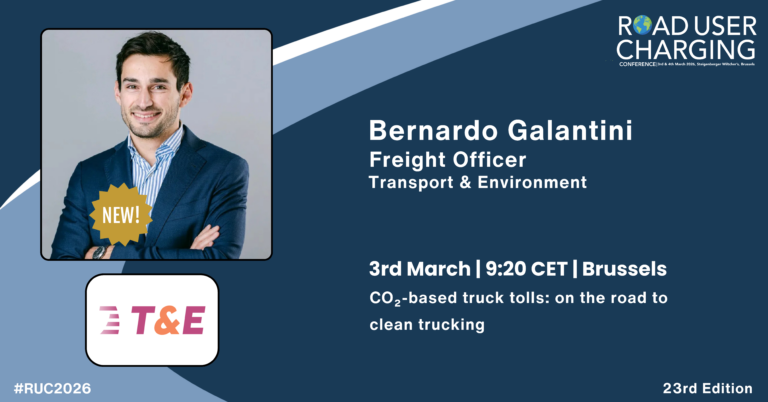
One of the experts confirmed to speak at the event is Bernardo Galantini, freight officer at Transport & Environment.
Bernardo works on advancing Europe’s transition to zero-emission trucks, with a focus on EU policies that support and accelerate their uptake.
He represents T&E in several industry associations and coordinates the Policy Working Group of the European Clean Trucking Alliance.
He has also contributed to EU climate legislation, including the ETS2 and the Effort Sharing Regulation.
At the conference, he will discuss CO₂-based truck tolls on the road to clean trucking and how further reducing the operational costs of zero-emission trucks is key for Europe’s industry to switch to clean trucks.
This includes delving into the plans several EU Member States already apply CO₂-based truck tolls, giving companies the needed investment certainty
 Name: Bernardo Galantini
Job Role: Freight Officer
Organisation: Transport & Environment
What is the best aspect of your job?
The best part of my job is interacting with policymakers, civil society, industry players and operators who are engaged in Europe’s shift towards zero-emission transport. I enjoy helping to overcome challenges on the path towards a socially just, zero-emission future.
What is the biggest challenge facing those with responsibility for user-financed transportation in 2026?
The main challenge will be ensuring coherence and credibility. User-financed transport systems are increasingly expected to deliver on multiple objectives at once: funding infrastructure, reducing emissions, ensuring fairness for users, and supporting industrial transition. Swiftly moving towards CO2-based tolling systems will be critical.
What’s your best piece of advice for those looking to implement user-financed transportation solutions?
Design systems that are simple, predictable and clearly linked to policy objectives. And, importantly, involve users early on.
Does legislation help or hinder development in the sector?
EU legislation – and in particular the Eurovignette Directive – clearly goes in the right direction. While several Member States are already implementing it, more needs to be done to ensure timely and full implementation.
How will the business of user-financed transportation have changed by 2030?
CO2-based tolls, combined with schemes that support zero-emission vehicles, will be the norm. User-financed transport will be a key policy lever to steer clean investments.
Why are you looking forward to speaking at Road User Charging Conference 2026?
The Conference offers a platform to exchange ideas and learn from experienced practitioners across Europe. It’s an excellent opportunity to connect policy discussions with real-world implementation and to reflect on how road charging can best support the transition to sustainable transport.


 Discover the key trends and challenges shaping the future of user-financed transportation –spanning tolling, pricing and road usage charging – at Akabo Media’s