

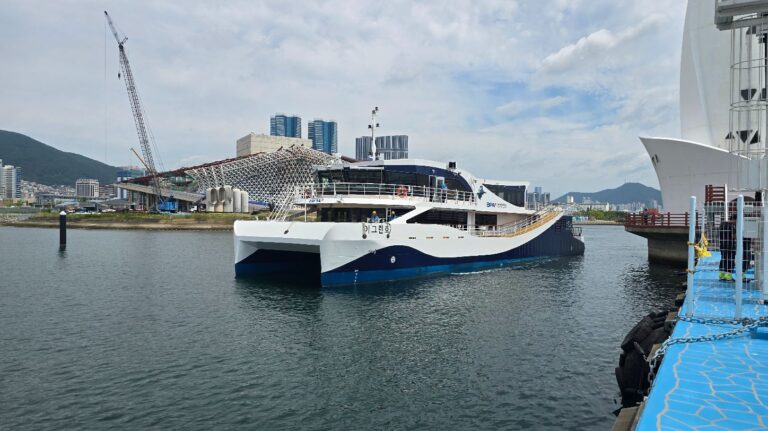
Busan Port Authority (BPA) has launched South Korea’s first state-owned all-electric ferry for passenger services, marking a key milestone in the country’s wider programme to decarbonise its port and maritime operations.
Built by Busan-based Kangnam Corporation, the vessel will operate on the North–South Port connection in Busan, providing a zero-emission alternative to conventionally powered harbour craft on one of the city’s core passenger links.
The new ferry is the first realised asset in a national plan by South Korean authorities to replace 140 state-owned vessels with cleaner-energy ships by 2030, in line with environmental legislation. This forms part of the country’s Green New Deal, which sets a national goal of achieving net-zero emissions by 2050.
Woong-Ki Lee, port manager at BPA, said the project reflected a strategic shift towards cleaner day-to-day port operations rather than only focusing on oceangoing shipping.
“This vessel demonstrates Busan Port Authority’s commitment to cleaner, smarter port operations,” he said. “By introducing an all-electric ferry to serve our North–South Port connection, we are reducing local emissions and noise while providing a replicable model for future harbour craft.”
The ferry is equipped with two 1,068kWh battery packs that enable fully electric operation. According to BPA, a full charge using 500kW shore power takes around one hour and 30 minutes and provides approximately two hours of operation, matching the duty cycle required for its harbour service profile.
While alongside, the vessel is connected to a shore charging station via an optical communication link, allowing automatic control of charging and discharging from on board. This set-up is intended to minimise manual intervention, support predictable turnaround times and integrate charging into port energy management systems.
On board, a DC-based power distribution and energy management arrangement controls how battery output is delivered to propulsion and hotel loads, with built-in fault-tolerance and remote monitoring. During operations, the ferry is remotely supported via a global network of collaborative operations and diagnostic centres, enabling condition monitoring, data analysis and early fault detection.
Lee said the combination of energy storage and integrated power management was key to delivering a reliable passenger service. “ABB’s integrated electric propulsion and energy storage system has given us the efficiency, safety, and reliability we need to deliver a better experience for passengers and a healthier environment for our city,” he added.
The vessel is intended to act as a demonstrator for further state-owned and port-operated craft, including workboats and additional passenger ferries, as Korean authorities move to implement their 2030 replacement plan.
Subscribe for free to the quarterly print edition of CiTTi Magazine for exclusive insights into the key business issues shaping the future of sustainable urban mobility. Stay ahead of the curve by signing up for the free CiTTi weekly newsletter, delivering sector-leading content straight to your inbox every Friday. For even more updates, follow CiTTi Magazine on X (formerly Twitter) and LinkedIn. LinkedIn followers can also subscribe to Urban Digest — a weekly newsletter curated exclusively for the CiTTi Magazine LinkedIn community.